A New Lens on Education
Fjord Day School began with a deceptively simple question:
If we could design a school for children growing up today—with no preconceived notions about what school is supposed to look like—what would we create?
For generations, the basic structure of school has remained remarkably familiar. Students are grouped primarily by age. Learning is divided into subjects and scheduled into blocks of time. Teachers deliver curriculum. Students demonstrate what they know. The world around our children, however, has changed dramatically.
We believe education can change with it.
At Fjord, we are willing to examine every part of the traditional school experience and ask whether it serves the children in front of us. We don't reject tradition simply because it is old, and we don't embrace innovation simply because it is new. Instead, we draw from research in gifted education, Finnish-inspired educational practices, STEAM learning, and the inquiry-based principles found in the International Baccalaureate approach.
Learning Begins With Questions
We believe some of the most powerful learning begins not with an answer, but with a question.
Students are encouraged to wonder, investigate, make connections, challenge assumptions, and pursue ideas beyond the boundaries of a traditional lesson. Teachers serve not only as sources of knowledge, but as skilled guides who know when to provide direct instruction, when to ask the next great question, and when to step aside and let a student's curiosity lead.
Inquiry doesn't mean children are expected to discover everything on their own. Strong foundational knowledge and explicit teaching matter. But knowledge becomes more powerful when students learn how to use it—to investigate unfamiliar problems, evaluate evidence, develop ideas, consider different perspectives, and communicate what they discover.
That means school can look different here.
Students can move beyond material they have already mastered. A question about a local stream might become an ecological investigation, a mathematical analysis, an engineering challenge, a piece of persuasive writing, and a conversation about human impact. Students learn that the world doesn't arrive neatly divided into subjects—and their education doesn't always need to be, either.
Our goal is not simply to create students who know a great deal.
We want to develop curious, capable, creative thinkers who know how to ask meaningful questions, seek evidence, reflect on what they discover, and use what they know to create something new.
Fjord isn't defined by any single educational model or methodology. We take the strongest ideas from each and continually return to one question:
Is this the best way to help this child learn?
And when the answer is no, we are willing to imagine something better.


Learning Without Grade-Level Limits
At Fjord, we believe a child’s age tells us remarkably little about what they are ready to learn.
Traditional schools organize children primarily by birthdate: first graders learn with first graders, second graders with second graders, and students generally move through the same curriculum at the same pace. At Fjord, we take a different approach. Students belong to mixed-age learning communities while moving into flexible instructional groups based on their demonstrated readiness, interests, and learning needs.
A child may be ready for advanced mathematics while needing more time to develop as a writer. Another may demonstrate extraordinary scientific reasoning while working at a different level in reading. Rather than requiring those children to fit a single grade-level designation, we meet them where they are—and provide a pathway for continued growth.
This approach is particularly important for advanced and gifted learners. The National Association for Gifted Children recommends grouping students according to learning aptitude and demonstrated readiness, noting that chronological age alone may be an insufficient indicator of academic readiness. NAGC also distinguishes flexible grouping from tracking: students should be able to move among instructional groups as their knowledge, skills, and needs change.¹
The broader research supports this distinction. A major synthesis of approximately 100 years of research found positive academic effects for within-class grouping, cross-grade subject grouping, and specialized grouping for gifted learners, while traditional between-class ability grouping showed little benefit.² Earlier research in elementary education similarly found that grouping is most effective when placements are regularly reassessed and teachers adjust the level and pace of instruction to students' needs.³
For advanced learners, this flexibility also creates natural opportunities for subject acceleration and curriculum compacting. Students who demonstrate mastery do not need to spend weeks practicing material they already know; they can move into deeper, more complex, or more advanced work. Research syntheses have consistently identified acceleration as an effective educational intervention for high-ability students.² ⁴
At Fjord, this means we don't ask:
“What should a third grader be learning?”
We ask:
“What is this child ready to learn next?”
Students still experience the stability and belonging of a consistent mixed-age community, but instruction can move across traditional grade boundaries. Mathematics and literacy workshops may be organized by readiness. Inquiry and STEAM studios may bring students together around shared interests and questions. Collaborative projects intentionally mix ages, perspectives, and strengths.
The goal isn't to move every child faster.
The goal is to remove arbitrary ceilings—and allow every child to keep growing.
Research Behind Our Approach
National Association for Gifted Children. Grouping for Gifted Learners (2025). NAGC supports readiness-based grouping and emphasizes flexible movement rather than rigid tracking.
Steenbergen-Hu, S., Makel, M. C., & Olszewski-Kubilius, P. (2016). What One Hundred Years of Research Says About the Effects of Ability Grouping and Acceleration on K–12 Students' Academic Achievement: Findings of Two Second-Order Meta-Analyses. Review of Educational Research, 86(4), 849–899. https://doi.org/10.3102/0034654316675417
Slavin, R. E. (1987). Ability Grouping and Student Achievement in Elementary Schools: A Best-Evidence Synthesis.Review of Educational Research, 57(3), 293–336. https://doi.org/10.3102/00346543057003293
Steenbergen-Hu, S., & Moon, S. M. (2011). The Effects of Acceleration on High-Ability Learners: A Meta-Analysis.Gifted Child Quarterly, 55(1), 39–53. https://doi.org/10.1177/0016986210383155
Is Fjord right for our child?
Fjord is designed for bright, curious children who learn quickly, think deeply, and thrive when they are allowed to explore ideas beyond traditional grade-level boundaries.
We intentionally serve a somewhat broader community than a traditional gifted program. Our students may be formally identified as gifted, demonstrate advanced academic potential, or simply show the curiosity, reasoning, creativity, and readiness to benefit from an accelerated and inquiry-rich environment.
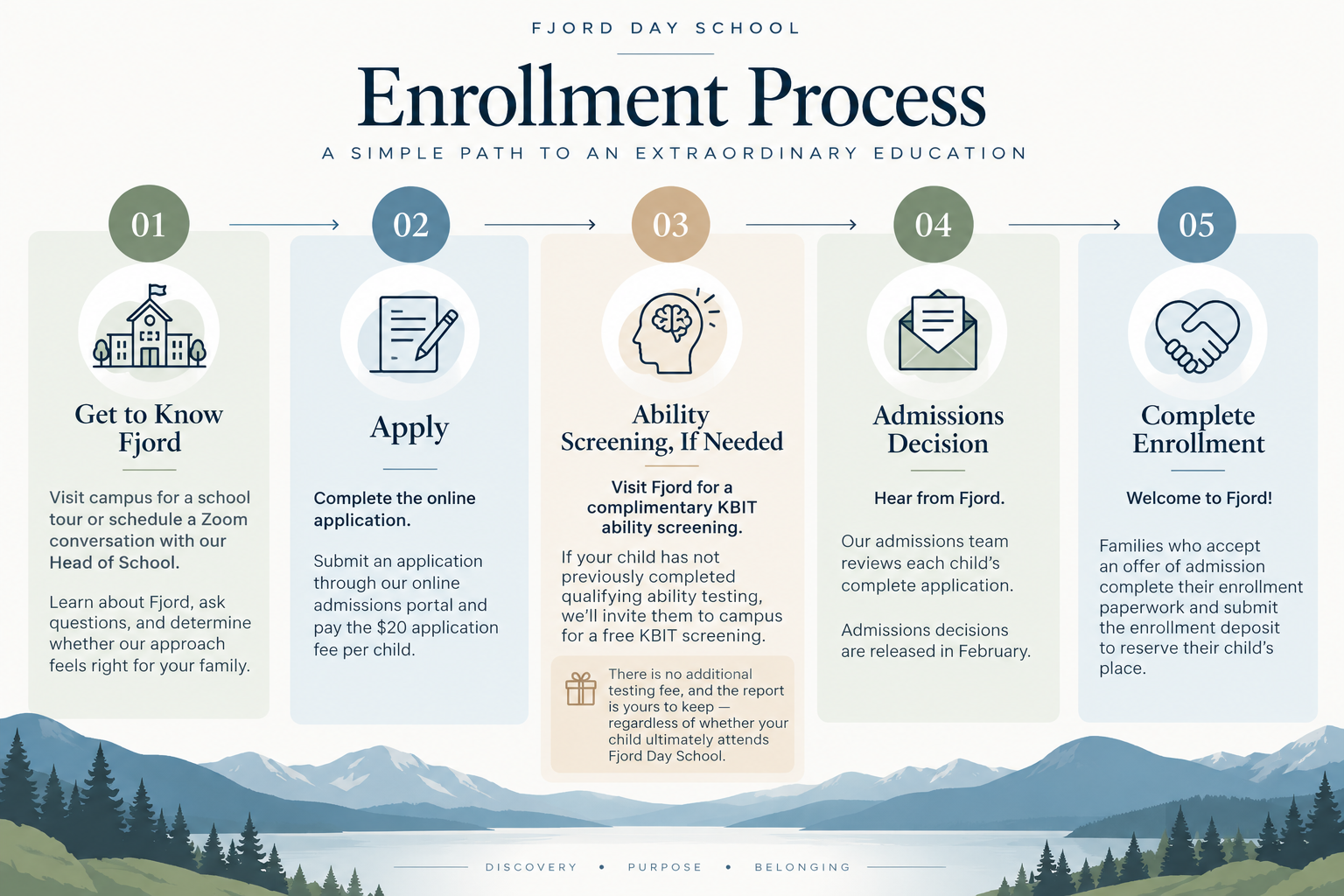
Beginning at age four, applicants complete a brief cognitive screening as one part of our admissions process. Rather than establishing a traditional gifted-IQ cutoff, Fjord uses a KBIT score of approximately 110 as an initial indicator of readiness, considered alongside the child's developmental history, interests, observed learning behaviors, and other available information. For three-year-olds, for whom cognitive scores are particularly unstable, we instead use a developmentally appropriate gifted-characteristics checklist and observation process.
There is an important reason for this broader approach: giftedness cannot be reduced to a single test score.
The National Association for Gifted Children recommends using multiple measures rather than relying on a single intelligence or achievement test. NAGC specifically notes that traditional testing can overlook gifted students from culturally and linguistically diverse backgrounds, students with disabilities, English-language learners, and students from lower-income families. NAGC also cautions that IQ determinations are particularly difficult to make reliably in children younger than six.¹
Research supports casting a wider net. In a large-scale study of universal gifted screening, Card and Giuliano found that changing how children were identified substantially increased identification among economically disadvantaged, Black, Hispanic, English-learning, and other historically underidentified students—without lowering the district's established qualification standard.² Colorado similarly recommends evaluating giftedness through a body of evidence rather than treating a single composite cognitive score as a complete description of a child's abilities.³
Fjord's intentionally broader admissions range also creates a community of intellectual peers without requiring every child to have an identical cognitive profile. Children may have extraordinary strengths in mathematics, language, spatial reasoning, creativity, scientific thinking, leadership, or other areas—and their development may be uneven across those domains.
We believe that variation is valuable.
Research on the big-fish-little-pond effect has found that highly able students' academic self-concept can decline when their comparison group consists exclusively of similarly exceptional students.⁴ ⁵ Fjord therefore seeks to create an intellectually stimulating community with a meaningful range of strengths and abilities rather than a school in which admission depends upon reaching an exceptionally high IQ cutoff.
The result is a learning community that looks more like the world our students will eventually enter: full of smart, interesting people who are good at different things.
At Fjord, a child doesn't have to be the smartest person in every room—and doesn't have to spend every day being the child who already knows the answer.
Sometimes they will lead.
Sometimes they will struggle.
Sometimes they will teach.
Sometimes they will learn from someone whose mind works completely differently from their own.
We think all four experiences matter.
Our Admissions Philosophy
Assessment helps us answer one central question:
Is Fjord an environment in which this child is likely to thrive?
A test score gives us useful information. It does not define a child.
Research & Guidance
National Association for Gifted Children. Assessments & Tests and The Role of Assessments in the Identification of Gifted Students. NAGC recommends multifaceted assessment and cautions against relying upon a single test for gifted identification.
Card, D., & Giuliano, L. (2016). Universal screening increases the representation of low-income and minority students in gifted education. Proceedings of the National Academy of Sciences, 113(48), 13678–13683. https://doi.org/10.1073/pnas.1605043113
Colorado Department of Education. Gifted Identification Guidance Handbook and Matrix of Commonly Used Assessments for Gifted Identification.
Zeidner, M., & Schleyer, E. J. (1999). The big-fish-little-pond effect for academic self-concept, test anxiety, and school grades in gifted children. Contemporary Educational Psychology, 24(4), 305–329. https://doi.org/10.1006/ceps.1998.0985
Marsh, H. W., Chessor, D., Craven, R., & Roche, L. (1995). The effects of gifted and talented programs on academic self-concept: The big fish strikes again. American Educational Research Journal, 32(2), 285–319. https://doi.org/10.3102/00028312032002285